Compare Mazda CX-30 vs CX-5 vs Subaru Forester prices in Kenya, ground clearance, petrol vs diesel fuel economy, KRA duty, and NTSA buying checks (2026).
Mazda CX-30 vs. Mazda CX-5 vs. Subaru Forester in Kenya: Which Crossover Should You Buy in 2026?
When choosing between the Mazda CX-30, Mazda CX-5, and Subaru Forester in Kenya, buy the Mazda CX-30 if you want newer 2020-era styling and responsive urban fuel economy near KES 3.1 million, choose the Mazda CX-5 if you need balanced five-seat family comfort and up to 193 millimetres of ground clearance from roughly KES 1.6 million to KES 4.1 million, and pick the Subaru Forester if you tackle steep murram tracks or muddy upcountry terrain where 220 millimetres of ground clearance and full-time symmetrical all-wheel drive make the decisive difference. Whichever model fits your commute, inspecting physical units already landed in Nairobi or Mombasa lets you verify KRA Kenya Dealer (KD) customs records, NTSA e-Logbook ownership, and unpaid traffic fines before paying a shilling.
Across Nairobi, Kiambu Road, Ngong Road, Mombasa, and Nakuru, crossovers have steadily overtaken traditional station wagons and executive saloons as Kenya's preferred upgrade segment. Rising locally used baseline prices above the one-million-shilling threshold have pushed upwardly mobile households and business owners into the KES 2 million to KES 4.2 million crossover bracket, helped along by 60-month to 72-month commercial bank asset financing ahead of December travel. At the same time, fresh import rules, fluctuating customs valuations, and volatile retail fuel pumps make picking the wrong engine or trim an expensive mistake.
On kemotives, buyers can compare live asking prices across physical Foreign Used and Locally Used vehicles standing on Kenyan ground rather than gambling on blind overseas import promises. Checking real specifications, genuine fuel economy trade-offs, and late-2026 Kenyan legal checks side by side ensures you drive home in a crossover built for your actual roads and servicing budget.
All statutory fuel tariffs, KEBS KS 1515:2019 import deadlines, KRA customs valuation rules, and NTSA verification procedures in this guide have been reviewed against official Kenyan regulatory publications as of 20 November 2026.
How Do the Mazda CX-30, Mazda CX-5, and Subaru Forester Compare on Price in Kenya in 2026?
In late 2026, typical Kenyan asking prices place locally used KE-series Mazda CX-5 and SJ-series Subaru Forester units between KES 1,550,000 and KES 3,500,000, while newer KF-series CX-5s, 2020 Mazda CX-30s, and SK-series Foresters generally ask between KES 2,750,000 and KES 4,400,000 depending on mileage, drivetrain, and import status. Understanding how condition status, model year, and Kenyan yard demand shape these brackets prevents you from overpaying or falling for suspiciously underpriced online bait.
Evaluating a Mazda CX-30 vs. CX-5 price in Kenya in 2026 alongside a used Mazda CX-5 vs. Subaru Forester price in Kenya requires separating older Kenyan-registered examples from recently landed duty-paid imports. Because Kenya's eight-year import limit restricts fresh arrivals to 2019 and newer registrations through 31 December 2026, older generations sit exclusively in the locally used market while 2019 and 2020 units dominate foreign-used showroom floors.
Foreign Used Mazda CX-30 (2019 to 2020) Price in Kenya: Across Nairobi showrooms, a foreign used Mazda CX-30 2020 price in Kenya typically spans KES 2,550,000 to KES 3,500,000 for clean 20S and X L Package units, depending on mileage, auction grade, and whether the car carries Front-Wheel Drive or i-Activ AWD. On the dedicated Mazda CX-30 Price Guide on kemotives, live tracking across three active 2020 listings (last updated 31 October 2026) shows a typical median asking price of KES 3,100,000, with Good price deals falling at or below KES 2,790,000, Fair price listings between KES 2,790,000 and KES 3,410,000, and the middle half of listings asking between KES 2,380,000 and KES 3,150,000. Two live 2020 CX-30 listings in Nairobi (a 20S L Package with 29,000 km and an X L Package with 75,000 km) ask KES 3,100,000 and KES 3,200,000, while a third 2020 listing sits at KES 1,650,000 with 97,000 km and a 1,500cc figure typed on the listing. As noted on the price guide itself, any outlier priced far below the typical median should prompt an immediate physical check of the chassis code, customs history, and accident record rather than assuming a windfall bargain.
Used Mazda CX-5 Price on Kiambu Road, Nairobi, and Locally Used Ranges: As Kenya's single highest-volume Japanese mid-size crossover, the CX-5 spans two major generations on Kenyan roads. First-generation KE-series models (2012 to 2016), now exclusively Kenyan-registered, generally ask KES 1,550,000 to KES 2,250,000, with a clean locally used Mazda CX-5 2.0 petrol in Nairobi for sale by owner typically commanding a slight premium over unverified diesel examples due to city durability. Stepping up to second-generation KF-series units (2017 to 2018 locally used) brings prices into the KES 2,300,000 to KES 2,950,000 range; for example, a live 2017 Mazda CX-5 (2.2-litre diesel automatic, 106,000 km) listed in Kiambu on kemotives asks KES 2,850,000. Freshly cleared 2019 and 2020 KF-series showroom imports along Kiambu Road and Ngong Road typically range from KES 2,950,000 to KES 4,100,000, depending on 20S petrol, XD diesel, or 25S petrol trims.
Subaru Forester SJ Locally Used Price vs. SK Foreign Used Price in Kenya: Kenyan buyers comparing the Subaru Forester SJ locally used price against newer imports must distinguish cleanly between the fourth and fifth generations. Because production of the fourth-generation SJ series (2013 to 2018) ended in 2018, SJ Foresters are no longer eligible for fresh importation under the eight-year age cap and trade strictly as locally used cars. Clean non-turbo SJ5 (2.0i FB20) units ask roughly KES 2,150,000 to KES 2,900,000, while sought-after turbocharged SJG Forester XT (FA20DIT) editions command KES 2,750,000 to KES 3,500,000 because enthusiasts prize their sports-car acceleration. Fifth-generation SK-series Foresters (2018 to 2022+), powered by the 2.5-litre FB25 engine (SK9) or 2.0-litre e-Boxer mild hybrid (SKE), typically list between KES 3,200,000 and KES 4,400,000 for 2019 and 2020 units, offering upgraded EyeSight safety technology and stiffer cabin construction.
You can browse live Mazda listings on kemotives, inspect all three Mazda CX-30 units for sale, or explore all vehicles for sale in Kenya as new dealer stock arrives. Note that while kemotives carries active Mazda CX-30, Mazda CX-5, and seven-seat Mazda CX-8 stock, Subaru Forester inventory on kemotives currently represents an open gap for dealers and private owners looking to reach crossover shoppers directly.
Ground Clearance, Suspension, and December Upcountry Road Readiness
For Kenyan roads, the Subaru Forester offers the highest underbody protection at 220 millimetres of ground clearance paired with standard full-time symmetrical all-wheel drive, the Mazda CX-5 sits comfortably in the middle at 185 to 193 millimetres, and the Mazda CX-30 comes in lowest at 175 to 180 millimetres with a stiffer, road-tuned chassis. Choosing among them depends less on brochure horsepower than on how much unpaved murram, steep escarpment gravel, and passenger luggage your car carries outside Nairobi.
Road conditions across Kenya test suspension geometry quickly. Unpainted residential speed bumps in Kahawa Sukari, Syokimau, or Kitengela, paired with heavy rains and rural access tracks heading toward Nyeri, Kisii, Meru, or Eldoret, quickly expose the difference between a raised hatchback crossover and a true all-terrain family SUV.
How the Mazda CX-30 Handles Nairobi Tarmac and Light Gravel
Built on Mazda's fourth-generation SkyActiv-Vehicle Architecture shared with the modern Mazda 3, the Mazda CX-30 drives more like an elevated European sports hatchback than a tall family utility vehicle. Its 175 to 180 millimetres of ground clearance comfortably clears standard urban potholes, mall ramps, and moderate estate bumps without scraping, and its firmer suspension tuning virtually eliminates highway body roll along Waiyaki Way or the Nairobi Expressway.
However, the CX-30's compact footprint brings clear spatial trade-offs for holiday trips. Its rear legroom feels noticeably tighter for tall adults sitting behind a six-foot driver than a CX-5 or Forester, and its boot capacity sits near 430 litres, meaning four adults packing heavy Christmas luggage will fill the rear compartment quickly. Additionally, most JDM CX-30 imports arriving in Nairobi are Front-Wheel Drive (2WD) rather than i-Activ AWD, making them suited to tarmac highways and dry rural lanes rather than deep black-cotton mud.
Why the Mazda CX-5 Is Kenya's All-Round Family Crossover
The Mazda CX-5 earned its dominant reputation along Kiambu Road and Ngong Road because it balances sleek executive design with practical family volume and generous ground clearance. Offering 185 to 193 millimetres of ground clearance depending on whether the vehicle rides on 17-inch or 19-inch alloy wheels, the KF-series CX-5 glides over uneven highway expansion joints, rough murram feeder roads, and flooded urban roundabouts with minimal fuss.
Inside the cabin, the CX-5 provides superior rear-seat knee room, wider shoulder space for three passengers across the second row, and a deeper, roughly 505-litre boot that swallows travel bags, strollers, and farm produce effortlessly. Buyers can choose between lighter Front-Wheel Drive models for everyday Nairobi commuting or i-Activ All-Wheel Drive variants that proactively send torque to the rear wheels when front tyres encounter slick tarmac or wet uphill mud.
Why the Subaru Forester Dominates Upcountry Terrain
Where smooth highway tarmac ends and rutted, steep, or flooded rural roads begin, the Subaru Forester pulls decisively ahead. Both the fourth-generation SJ and fifth-generation SK Foresters deliver a commanding 220 millimetres of ground clearance, matching or exceeding several traditional body-on-frame four-wheel drives while maintaining car-like comfort on the Mombasa highway.
Crucially, every standard Kenyan-market Forester features Subaru's Symmetrical All-Wheel Drive permanently engaged across all four wheels, backed by X-Mode terrain electronics that modulate throttle mapping, gearbox ratios, and selective wheel braking down steep muddy slopes. Coupled with near-vertical side windows, slim roof pillars that erase blind spots when navigating narrow village bridges, and deep boxy cargo height, the Forester remains the benchmark choice for households traveling frequently into highland tea, coffee, or Rift Valley farming zones.
Engine Options, Real-World Fuel Economy, and Reliability on Kenyan Fuel
Among the best fuel economy crossovers in Kenya in 2026, the Mazda CX-30 (20S petrol and SkyActiv-X mild hybrid) leads urban pump efficiency at 12 to 17 kilometres per litre, followed closely by the 2.0-litre petrol Mazda CX-5 at 11 to 14 kilometres per litre and the non-turbo Subaru Forester SJ5 or SKE e-Boxer at 10.5 to 15 kilometres per litre, while turbocharged Forester XTs and neglected 2.2-litre diesels carry noticeably higher running expenses.
Under the Energy and Petroleum Regulatory Authority (EPRA) price review for November 15 to December 14, 2026, Nairobi retail pump caps hold steady at KSh 226.96 per litre for Super Petrol and KSh 227.76 per litre for Diesel. Because diesel currently costs more per litre than super petrol at Kenyan stations, fuel choice has shifted sharply away from automatic diesel preference toward simpler, trouble-free naturally aspirated petrol engines and mild hybrids.
Mazda CX-30 Powertrains: 20S 2.0-Litre Petrol vs. X L Package Mild Hybrid
Kenyan buyers inspecting 2020 Mazda CX-30 listings will encounter two primary petrol engines alongside a rarer diesel option, and knowing the difference directly impacts both fuel economy and workshop parts availability:
20S and 20S L Package (1,997cc SkyActiv-G Petrol): Powered by Mazda's proven PE-VPS 2.0-litre naturally aspirated four-cylinder petrol engine paired with a conventional six-speed automatic transmission, this is the safest all-round CX-30 variant for Kenya. Delivering roughly 156 horsepower and 12 to 15 kilometres per litre in mixed Nairobi commuting, it uses widely understood spark plugs, standard synthetic 0W-20 oil, and mechanical components shared with the popular CX-5 and Axela.
X L Package (1,997cc e-SkyActiv-X Mild Hybrid): Using Mazda's sophisticated Spark Controlled Compression Ignition (SPCCI) technology assisted by a 24-volt M Hybrid belt-integrated starter generator, the X L Package bumps output near 180 horsepower while stretching real-world economy to 14 to 17 kilometres per litre. However, its high-compression combustion hardware relies on specialized sensors, clean high-octane unleaded petrol, and a high-pressure supercharging air pump, meaning routine servicing should be entrusted strictly to experienced Nairobi Mazda specialists rather than roadside mechanics.
Confirming Engine Displacement Against Listing Specs: While inspecting listings online, always open the bonnet and inspect the chassis plate (DMEP for the 2.0-litre SkyActiv-G versus DMFP for the SkyActiv-X mild hybrid). Occasionally, local sellers mistype a smaller displacement such as 1,500cc into an online listing when uploading a CX-30, so confirming the exact cubic capacity on the Japanese Export Certificate and KRA entry prevents surprises during insurance valuation and NTSA registration.
Mazda CX-5 2.2 Diesel vs. 2.0 Petrol in Kenya: Reliability and Servicing Costs
Debating Mazda CX-5 2.2 diesel vs. 2.0 petrol reliability in Kenya is the single most important technical decision for CX-5 shoppers, and your daily driving pattern determines which engine stays reliable.
2.0-Litre SkyActiv-G Petrol (1,997cc, 20S): Producing roughly 155 to 165 horsepower through a crisp six-speed torque-converter automatic, the 2.0L petrol averages 11 to 14 kilometres per litre in combined Kenyan traffic. It lacks turbochargers, Diesel Particulate Filters (DPFs), and complex diesel soot traps, allowing it to shrug off short 15-minute school runs along Ngong Road or slow crawl-speed congestion in Westlands without carbon choking. For urban Nairobi families, the 2.0-litre petrol (or the larger 2.5-litre 25S petrol averaging 9.5 to 12.5 kilometres per litre with stronger overtaking reserve) delivers vastly lower unscheduled repair risk.
2.2-Litre SkyActiv-D Twin-Turbo Diesel (2,188cc, XD / XD L Package): Generating massive low-end torque (420 to 450 Nm) and returning 13 to 16 kilometres per litre on open intercity highways, the 2.2D feels effortlessly strong climbing the Rift Valley escarpment with five passengers aboard. Yet its reputation in Kenya suffers whenever owners treat it like a short-hop town car. Stop-start Nairobi gridlock prevents the Diesel Particulate Filter from reaching active regeneration temperatures, causing unburnt diesel to dilute engine oil and clog the Exhaust Gas Recirculation (EGR) valve and intake manifold with thick carbon sludge. If you choose a 2.2L SkyActiv-D, service it strictly every 5,000 to 7,000 kilometres with 5W-30 ACEA C3 or JASO DL-1 low-ash synthetic oil, refuel only at high-turnover major stations, schedule regular highway runs, and insist on a pre-purchase OBD2 scan checking DPF differential pressure and injector flow correction values.
Subaru Forester XT Turbo vs. Non-Turbo FB20, SK9 2.5L, and e-Boxer Reliability
Comparing a Subaru Forester XT vs. non-turbo in Kenya comes down to trading thrilling highway pace for controlled fuel and mechanical bills:
SJ5 2.0i Non-Turbo (1,995cc FB20 Petrol): Delivering around 148 to 150 horsepower via Subaru's Lineartronic CVT, the naturally aspirated FB20 averages 10.5 to 13.5 kilometres per litre in mixed Kenyan use. While older FB20 units require vigilance on engine oil consumption, periodic valve-cover gasket seals, and scheduled CVT fluid replacement every 40,000 to 60,000 kilometres, a clean non-turbo SJ5 remains straightforward and affordable to keep running.
SJG Forester XT (1,998cc FA20DIT Turbo Petrol): Pumping out roughly 240 to 280 PS in JDM specification, the XT transforms a practical family SUV into one of the fastest crossovers on Kenyan highways. That performance comes at a clear price: real-world economy drops to 7.5 to 10.5 kilometres per litre in Nairobi traffic, high-pressure direct-injection components demand clean premium fuel and disciplined turbo cool-down habits, and worn suspension bushings or neglected CVT fluid heat-exchangers turn deferred maintenance into steep garage bills.
SK9 2.5L (2,498cc FB25) and SKE e-Boxer (1,995cc Mild Hybrid): On fifth-generation SK Foresters, Subaru retired the turbo XT in favor of the smooth 2.5-litre FB25 (182 to 184 horsepower, 9.5 to 12.5 kilometres per litre) and the 2.0-litre e-Boxer mild hybrid (12 to 15 kilometres per litre in urban commuting thanks to electric low-speed assist, at the expense of slightly raised boot floor space for its compact lithium-ion pack).
KRA CRSP Duty, Excise Bands, and the KEBS 2019 vs. 2020 Import Cutoff
Under KEBS KS 1515:2019 rules, 2019-registered crossovers such as 2019 Mazda CX-5s and 2019 Subaru Foresters must clear Mombasa Port by 31 December 2026 before import eligibility shifts strictly to 2020 and newer vehicles on 1 January 2027, triggering higher overseas purchase prices and customs valuations on incoming 2020 stock. Meanwhile, buyers importing or comparing mild-hybrid crossovers should note that standard petrol, diesel, and hybrid variants between 1,501cc and 2,500cc attract 25% KRA Excise Duty under current customs schedules rather than the 10% green-mobility excise rate reserved for 100% Battery Electric Vehicles (BEVs).
With only 41 days left until the year-end port deadline, understanding how Kenyan customs rules interact with these three crossovers helps you decide whether to buy landed local inventory right now or wait for next year's arrivals:
The KEBS 2019 vs. 2020 Car Import Cost Difference and 2027 Cutoff: Under the Kenya Bureau of Standards (KEBS) KS 1515:2019 eight-year age cap, any vehicle first registered in 2019 that lands on a delayed vessel clearing into January 2027 faces mandatory customs rejection, leaving the importer liable for re-exportation or destruction costs. Because the Mazda CX-30 launched late in 2019 as a 2020 model-year vehicle, nearly all incoming CX-30 units carry 2020 registrations and remain import-eligible throughout 2027, whereas 2019 Mazda CX-5 and 2019 Subaru Forester stocks enjoy their final weeks of maximum 70% KRA CRSP depreciation in 2026. Moving to 2020 imports next year forces buyers to absorb both higher Japanese auction FOB prices and a lower 60% depreciation discount on a six-to-seven-year-old unit, making already-cleared 2017 to 2019 CX-5s and Foresters sitting in Nairobi yards significantly stronger value today.
KRA CRSP Consultations and Mild-Hybrid Excise Reality: Buyers searching about hybrid car excise duty 10% vs. petrol 25% under KRA CRSP rules frequently assume mild hybrids such as the Mazda CX-30 SkyActiv-X or Subaru Forester e-Boxer qualify for Kenya's discounted 10% EV excise duty. In practice, Kenya Revenue Authority customs rules restrict the preferential 10% rate strictly to pure zero-emission Battery Electric Vehicles (BEVs) lacking an internal combustion engine and tailpipe. Crossovers combining a petrol engine with mild-hybrid assistance remain taxed by engine displacement at 25% excise duty (for engines from 1,501cc to 3,000cc), stacked sequentially on top of 35% Import Duty, 16% VAT, 2.5% Import Declaration Fee (IDF), and 2.0% Railway Development Levy (RDL). Worse still, higher-trim mild-hybrid variants often carry steeper brand-new showroom benchmarks in KRA's CRSP catalog, driving absolute landed taxes higher even within the same 25% band. Because High Court interim orders suspended KRA's July 2025 CRSP overhaul while mid-November 2026 stakeholder talks continue around a proposed CRSP Version II schedule, buying duty-paid showroom stock already landed in Kenya locks in a guaranteed Kenyan Shilling total.
NTSA Ownership Transfer Fees by Engine Capacity: On the official eCitizen NTSA Service Portal, statutory ownership transfer fees depend directly on cubic capacity recorded on the logbook. The 2.0-litre Mazda CX-30, 2.0-litre Mazda CX-5, and 2.0-litre Subaru Forester (SJ5, XT, and SKE e-Boxer) all sit inside the 1,701cc to 2,000cc bracket, costing KES 2,695 plus standard eCitizen portal charges. By contrast, the 2.2-litre diesel and 2.5-litre petrol Mazda CX-5, as well as the 2.5-litre Subaru Forester SK9, fall into the 2,001cc to 2,500cc bracket, attracting a KES 3,845 transfer fee.
For complete worked tax calculations and port logistics costs, read our guide to buying an imported car, the 8-year rule, and KRA CRSP duty alongside our step-by-step eCitizen NTSA transfer fee guide.
Essential NTSA Checks, Instant Fines, and KD Plate Verification Before Paying
Before transferring funds for any locally used or unregistered crossover in Kenya, you must verify the seller's title through a KES 550 Official NTSA Motor Vehicle Search on eCitizen, confirm zero pending traffic fines under NTSA's Instant Fines framework, inspect full customs release documents on any KRA Kenya Dealer (KD) plated showroom car, and complete an independent hoist and OBD2 diagnostic inspection.
Late-2026 regulatory updates make these pre-purchase checks indispensable whether you are buying from a private seller in Westlands or a dealership along Kiambu Road:
Authenticate Both e-Logbooks and Physical Logbooks via Official NTSA Search: Newly registered and transferred cars on eCitizen generate a digital e-Logbook featuring an encrypted QR code that you can scan via the official NTSA Mobile App or serviceportal.ntsa.go.ke. At the same time, existing physical paper logbooks remain legally valid following the August 2026 High Court conservatory order in Constitutional Petition No. E492 of 2026. Never trust a forwarded PDF alone: spend KES 550 inside your own eCitizen account to pull an Official Search confirming that the seller's National ID and KRA PIN match the registered owner and that no bank, SACCO, or microfinance asset-finance caveat blocks transfer.
Check Unpaid Traffic Fines and Avoid Instant Fines SMS Scams: Ahead of NTSA's signaled 26 November 2026 target to resume automated highway speed cameras and Instant Fines across corridors including Thika Road, Mombasa Road, Waiyaki Way, and Nairobi bypasses (contingent on clearing pending court matters), always confirm with the seller in person that zero unresolved traffic penalties remain attached to the plate. Crucially, NTSA explicitly warned motorists in November 2026 that Instant Fines are not paid through eCitizen. Authentic notices arrive solely via 22847_NTSA, with payments remitted exclusively through designated KCB branches and agents. Reject any phishing text asking you to clear an instant fine via eCitizen links or unfamiliar mobile-money paybills.
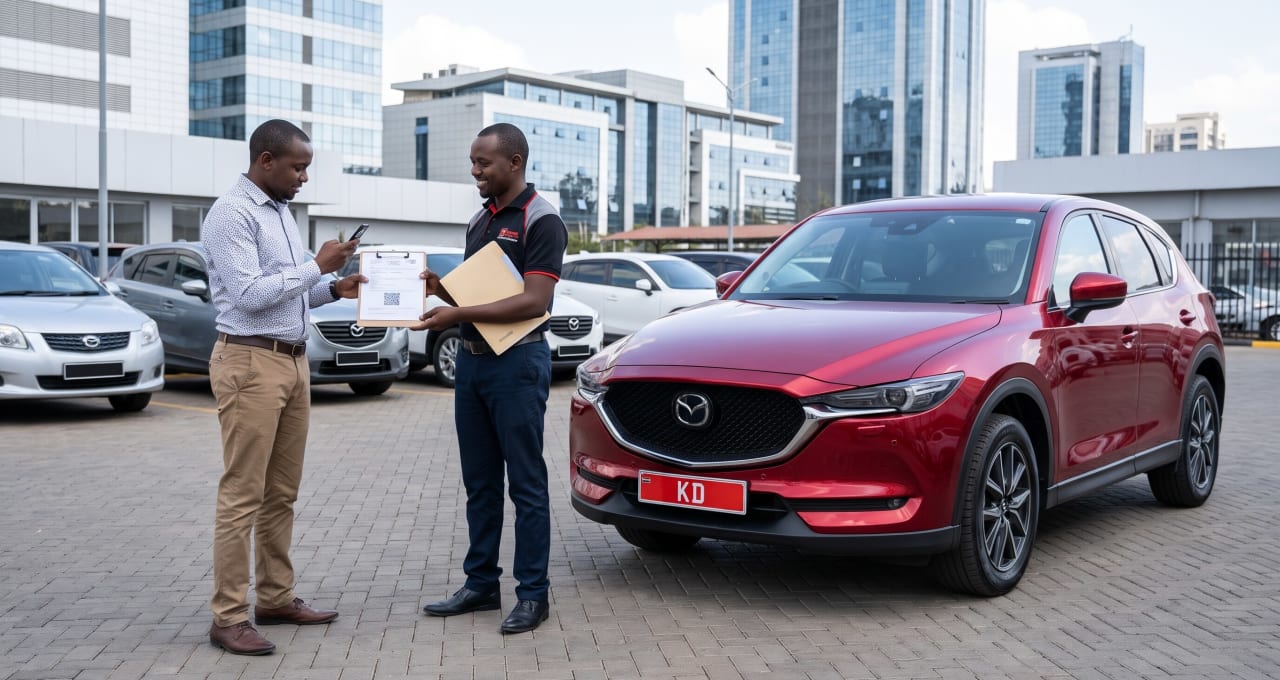
Verify KRA Customs Clearance and Section 24 Rules on KD Plates: If you inspect a newly landed 2019 or 2020 Mazda CX-30, CX-5, or Subaru Forester sporting red-and-white Kenya Dealer (KD) trade plates, confirm the dealer has settled all port taxes in KRA's iCMS system by inspecting the KRA Customs Entry, official KRA duty receipts, CFS Release Order, overseas Japanese Export Certificate, and QISJ Certificate of Roadworthiness matching the firewall chassis stamping. Under Section 24 of the Traffic Act (Cap 403), KD plates are restricted strictly to port transfers, inspections, and supervised test drives; NTSA enforcement against KD misuse carries penalties up to KSh 10,000. Never drive a purchased car upcountry on borrowed KD plates: require direct eCitizen first-registration into your National ID and KRA PIN upon payment.
Insist on Physical Viewing First and Zero Import Deposits: High-profile 2025 and 2026 High Court refund orders involving deposit-funded direct-import agencies underscore why physical viewing first with no deposit before viewing protects your capital. Reject "price on inbox" listings or M-Pesa reservation requests to hold a car unseen. Similarly, although NTSA deferred immediate roadside enforcement of annual inspections for private cars over four years old under the Traffic (Motor Vehicle Inspection) Rules, 2026 while testing-lane capacity expands, never skip a paid garage hoist check, auction-sheet verification (filtering out Grade R/RA accident cars and coastal or northern Japan salt corrosion), and full OBD2 diagnostic scan.
Review our guide to car import deposit safety, KD plates, and NTSA e-Logbooks and our pre-purchase inspection checklist for locally used cars in Kenya before closing your purchase.
Which Crossover Should You Choose? Final Decision Guide and Shopping Safely on kemotives
Selecting the right vehicle comes down to matching your daily road surface, passenger load, and servicing discipline to the strengths of each crossover, then inspecting real landed inventory with transparent asking prices.
Choose the Mazda CX-30 if: You commute primarily within Nairobi, Mombasa, or Kisumu, carry one to three passengers most days, prioritize refined 2020-era cabin ergonomics, and want brisk 2.0-litre petrol efficiency around 12 to 17 kilometres per litre benchmarked transparently against live asking medians on the Mazda CX-30 Price Guide.
Choose the Mazda CX-5 if: You want Kenya's cleanest balance of executive styling, five-person family comfort, a generous boot, and 185 to 193 millimetres of clearance. Pick a locally used or foreign-used 2.0-litre SkyActiv-G petrol if your weekly mileage stays mostly in city congestion, or choose a thoroughly inspected 2.2-litre SkyActiv-D diesel only if regular highway drives keep its DPF healthy.
Choose the Subaru Forester if: Rough rural murram roads, steep upcountry hills, muddy rainy-season tracks, and panoramic cabin visibility sit at the top of your list. Choose a clean locally used SJ5 2.0i non-turbo for predictable maintenance under KES 2.9 million, an SJG XT strictly if you budget for turbo upkeep and fuel, or a 2019 to 2020 SK Forester for modern chassis refinement and EyeSight safety.
On kemotives, buyers can browse all vehicles for sale, filter Foreign Used cars or Locally Used cars, and use our side-by-side vehicle comparison tool to evaluate up to four shortlisted crossovers simultaneously with zero account required. Every listing photo is processed automatically with Auto-Blurred number plates displaying only the registration prefix publicly so scammers cannot lift seller photos and clone registration plates; when you arrange an in-person viewing, simply request the full plate number to run your KES 550 eCitizen search.
Where at least three live listings share the same make, model, and year, such as our 2020 Mazda CX-30 listings, kemotives displays Good price, Fair price, or High price indicators anchored against median asking prices on the kemotives Price Guide (remembering that labels reflect live asking prices rather than completed sale prices or vehicle condition). Look for the Verified badge confirming our team approved the seller's identity and business documents, while remembering our core safeguards detailed under what kemotives checks and our Buying and Selling Safety Guide: kemotives does not physically inspect every vehicle or verify title ownership on your behalf, and never collects payment for a vehicle or offers escrow. You inspect the vehicle in person, agree the price directly with the seller, and pay only after completing official NTSA checks.
If you are upgrading your current car or managing a car yard holding clean Subaru Forester, Mazda CX-5, or Mazda CX-30 inventory, you can sell your car on kemotives directly to Kenyan buyers. Our free Starter plan (KES 0 monthly) supports up to 10 active listings with AI Vision photo spec auto-fill and automatic plate blurring, applying a 1% to 3.5% success fee only when a vehicle sells to a buyer introduced through the platform. Dealerships and frequent sellers upgrading on the kemotives pricing page, from Basic at KES 2,480 per month for 25 listings to Growth at KES 4,000 per month for 50 listings, pay 0% commission on sales and let signed-in buyers reveal their direct phone and WhatsApp numbers once KYC is approved. Compare all seller packages in our subscription plan guide.
Frequently Asked Questions About the Mazda CX-30, Mazda CX-5, and Subaru Forester in Kenya
1. What is the foreign used Mazda CX-30 2020 price in Kenya?
In late 2026, a foreign-used 2020 Mazda CX-30 in Kenya typically asks between KES 2,550,000 and KES 3,500,000 depending on mileage, drivetrain, and 20S versus X L Package trim. On the live Mazda CX-30 Price Guide on kemotives, active 2020 listings span KES 1,650,000 to KES 3,200,000 with a typical median asking price of KES 3,100,000, where Good price listings sit at or below KES 2,790,000.
2. Mazda CX-30 vs. Mazda CX-5: which has better ground clearance and cabin space in Kenya?
The Mazda CX-5 wins on both ground clearance and family cabin volume, offering 185 to 193 millimetres of clearance, generous second-row adult legroom, and a roughly 505-litre boot. The Mazda CX-30 sits slightly lower at 175 to 180 millimetres with a tighter rear bench and 430-litre boot, prioritizing agile city handling and sleeker dimensions over full five-adult holiday cargo capacity.
3. Is a Mazda CX-5 2.2 diesel or 2.0 petrol more reliable in Kenya?
For most Kenyan urban motorists, the 2.0-litre SkyActiv-G petrol Mazda CX-5 is significantly more reliable and cheaper to maintain than the 2.2-litre SkyActiv-D diesel, because stop-start city driving prevents the diesel's DPF from regenerating cleanly and clogs the EGR intake with carbon. With EPRA Nairobi diesel costing KSh 227.76 per litre compared with KSh 226.96 per litre for petrol, choose the 2.2D only if you cover frequent long highway distances, use clean high-turnover diesel, and change 5W-30 ACEA C3 or JASO DL-1 low-ash synthetic oil every 5,000 to 7,000 kilometres.
4. How much is a locally used Subaru Forester SJ vs. SK in Kenya, and should I buy the XT or non-turbo?
In 2026, locally used fourth-generation Subaru Forester SJ5 (2.0i non-turbo) units generally ask KES 2,150,000 to KES 2,900,000, while turbocharged SJG Forester XT editions command KES 2,750,000 to KES 3,500,000, and fifth-generation 2019 to 2020 SK Foresters trade between KES 3,200,000 and KES 4,400,000. Choose the non-turbo FB20 or SK9 2.5L if you want predictable fuel consumption (10.5 to 13.5 km/L) and controlled maintenance costs, and buy an XT only if you prioritize high performance and inspect turbo, fuel-system, and CVT service history carefully.
5. How do KRA CRSP rules, hybrid excise rates, and the KEBS 2019 cutoff affect crossover import costs?
Under KEBS KS 1515:2019, 2019-registered imports must clear Mombasa Port by 31 December 2026 before eligibility shifts to 2020 and newer vehicles on 1 January 2027, pushing up 2020 auction prices and reducing KRA depreciation allowances. In addition, mild-hybrid crossovers such as the CX-30 SkyActiv-X or Forester e-Boxer do not receive the 10% pure electric vehicle excise rate; because they retain a petrol engine between 1,501cc and 3,000cc, KRA taxes them at 25% Excise Duty alongside 35% Import Duty, 16% VAT, 2.5% IDF, and 2.0% RDL computed against their CRSP valuation.
6. What NTSA transfer fee, Instant Fines, and KD plate checks apply before buying a crossover in Kenya?
Statutory NTSA eCitizen transfer fees cost KES 2,695 for 2.0-litre models (1,701cc to 2,000cc) and KES 3,845 for 2.2-litre or 2.5-litre models (2,001cc to 2,500cc), plus platform charges. Before paying, run a KES 550 Official NTSA Search on eCitizen to verify ownership and zero bank caveats, confirm no unpaid traffic penalties ahead of NTSA's 26 November 2026 Instant Fines target (noting official fines arrive via 22847_NTSA and are paid via KCB branches or agents, not eCitizen), and verify full KRA customs receipts on any KD-plated unit so you avoid Section 24 Traffic Act penalties up to KSh 10,000.
7. Can I get bank asset financing for a Mazda CX-30, Mazda CX-5, or Subaru Forester in Kenya?
Yes, major Kenyan commercial banks including KCB, Equity, and NCBA routinely offer 60-month to 72-month asset financing on clean, recently imported 2019 and 2020 crossovers (and qualifying locally used models meeting lender age limits at loan maturity), typically requiring a 20% to 40% customer deposit, comprehensive insurance, an accredited valuer report, and clean NTSA title registration co-registered with the financier.
Ready to compare verified crossovers already standing in Kenya? Browse Mazda vehicles on kemotives, view live 2020 Mazda CX-30 listings, check median prices in the kemotives Price Guide, and review our Buying and Selling Safety Guide before scheduling your test drive.
Was this guide helpful?
Your feedback helps us keep our Kenyan car buying and selling guides accurate.