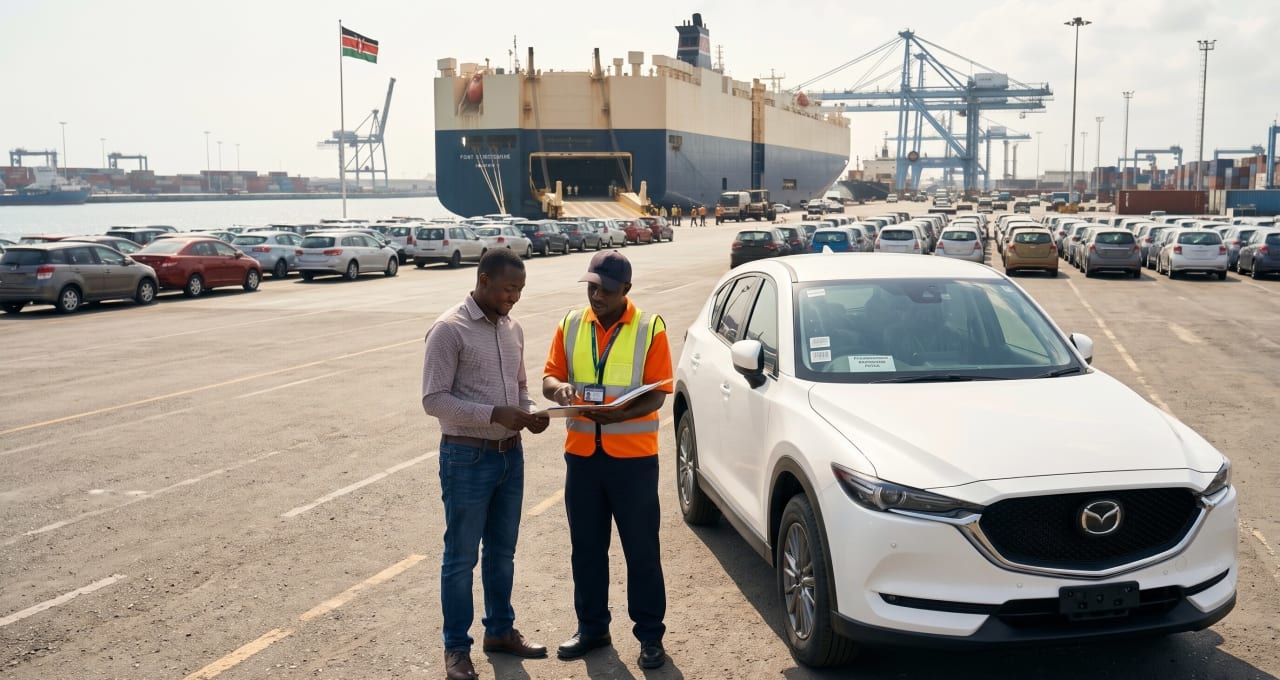
Complete guide to importing a car in Kenya, explaining how the KEBS 8-year age rule works, step-by-step KRA CRSP duty calculation formulas with worked examples, and Port of Mombasa clearing costs
To buy or import a foreign-used car into Kenya, the vehicle must strictly comply with the KEBS KS 1515:2019 eight-year age limit (meaning the difference between the calendar year of importation and the year of first registration must not exceed eight years), feature a right-hand-drive steering configuration, and carry a valid pre-export Certificate of Roadworthiness (CoR) issued by a KEBS-appointed agency such as QISJ or EAA. Import taxes collected by the Kenya Revenue Authority (KRA) are calculated using the official Current Retail Selling Price (CRSP) valuation schedule depreciated by up to 70% for age, applying a cascading formula of 35% Import Duty, 20% to 35% Excise Duty, 16% Value Added Tax (VAT), 2.5% Import Declaration Fee (IDF), and 2.0% Railway Development Levy (RDL), alongside approximately KES 100,000 to KES 170,000 in Port of Mombasa logistics, Container Freight Station (CFS) handling, clearing agent fees, and NTSA first-registration charges.
Importing a fresh pre-owned vehicle from Japan (commonly referred to as ex-Japan), the United Kingdom (ex-UK), or Singapore gives Kenyan motorists access to a broader range of trim specifications, independently verified low mileage, and factory suspension components untouched by local potholes. At the same time, navigating Kenya's statutory age cutoffs, multi-layered customs formulas, and port storage deadlines requires careful financial planning. Whether you intend to import a vehicle yourself through an overseas exporter or purchase an unregistered foreign-used car already standing in a Nairobi or Mombasa showroom, this guide walks you through every regulatory rule, tax calculation, and pre-purchase check from the overseas auction floor to your driveway.
All statutory tax formulas, KEBS compliance standards, and port handling fees in this guide have been verified according to official Kenya Revenue Authority (KRA), Kenya Bureau of Standards (KEBS), and Kenya Ports Authority (KPA) schedules as of November 2026.
Overview of Core Legal Requirements for Importing a Vehicle into Kenya
Before sending money to an overseas auction house or paying a deposit at a local car yard, every buyer should understand the six foundational rules that govern vehicle importation into Kenya and the financial penalties triggered by non-compliance:
Maximum Permitted Vehicle Age: Enforced by the Kenya Bureau of Standards under the KS 1515:2019 standard, an imported vehicle must not exceed eight years of age calculated from its year of first registration. Any vehicle that arrives at the Port of Mombasa outside this window faces mandatory rejection at customs, forcing the owner to pay for re-exportation or surrender the car for destruction at their own expense.
Right-Hand-Drive Steering Mandate: Regulated jointly by KEBS and the National Transport and Safety Authority (NTSA), only right-hand-drive (RHD) vehicles may be imported for normal road use in Kenya. Left-hand-drive (LHD) passenger cars are subject to an outright import ban, with rare exemptions granted strictly for specialized government ambulances, fire engines, or heavy off-highway construction equipment.
Mandatory Pre-Export Roadworthiness Inspection: Every used vehicle must be physically inspected prior to shipping by a KEBS-accredited agent such as Quality Inspection Services Inc. Japan (QISJ) or East Africa Automobile Services (EAA), which issues an official Certificate of Roadworthiness (CoR). Shipping a car without a valid CoR attracts a punitive 15% surcharge calculated on the Cost, Insurance, and Freight (CIF) value, plus mandatory local destination inspection fees at Mombasa.
Official KRA CRSP Tax Valuation Basis: The Kenya Revenue Authority Customs and Border Control department does not calculate taxes based on the purchase price printed on your foreign commercial invoice. Instead, KRA values every car strictly using its published Current Retail Selling Price (CRSP) database, ensuring that under-declaring an invoice price yields no tax reduction.
Cumulative Statutory Import Taxes: Importers must settle five sequential levies through KRA's Integrated Customs Management System (iCMS), comprising 35% Import Duty, 20% to 35% Excise Duty (or 10% for fully electric cars), 16% VAT, 2.5% IDF, and 2.0% RDL. Until these duties are paid in full, the vehicle remains held under customs bond.
Port and CFS Free Storage Deadlines: The Kenya Ports Authority (KPA) and designated Container Freight Stations (CFS) provide between 21 and 30 calendar days of free storage from the date the vessel discharges cargo. Exceeding this grace period triggers steep daily storage and shipping container demurrage charges ranging from USD 30 to USD 80 per day.
If you prefer to skip the shipping wait and customs clearing process altogether, you can browse ready-to-drive foreign used cars on kemotives with transparent asking prices and clear condition badges.
1. How the KEBS Eight-Year Age Rule Works in 2026 and Beyond
The eight-year age rule is the most strictly enforced regulation in Kenyan motor vehicle trade. Governed by KEBS KS 1515:2019 (Code of Practice for Inspection of Road Vehicles for Importation), the law stipulates that the numerical difference between the calendar year in which the car arrives in Kenya and the calendar year in which the car was first registered in its country of origin must not exceed eight years.
How to Calculate the Annual Cut-Off Year
Under Kenyan customs regulations, vehicle age is evaluated by whole calendar years rather than the exact month of manufacture or registration. For imports clearing customs during calendar year 2026, the oldest vehicles permitted to enter Kenya are those first registered in 2019 (alongside late-2018 units only where specific transition notices apply, though importers universally target 2019 and newer registrations to guarantee zero port disputes).
As soon as the clock strikes midnight on 1 January 2027, the statutory cutoff immediately advances by one full year to 2020. Every November and December, hundreds of Kenyan buyers suffer severe financial losses because cargo ships encounter bad weather, Red Sea routing delays, or berth congestion at the Port of Mombasa. If you purchase a 2019-registered vehicle in October 2026, and the vessel docks and lodges its customs manifest at Mombasa on or after 1 January 2027, KRA Customs and KEBS will classify the car as overage and refuse entry regardless of when you paid for the vehicle or when the ship departed Yokohama or Southampton. For this reason, experienced importers avoid shipping eight-year-borderline vehicles after early October.
Year of First Registration Versus Year of Manufacture
Buyers frequently ask whether Kenyan customs officers look at the year a car was built on the factory assembly line or the year it was first registered to a motorist overseas. KEBS and KRA apply three clear rules to resolve this distinction:
Japanese Imports (Ex-Japan): Every vehicle exported from Japan is accompanied by an official Japanese Deregistration or Export Certificate, known as the Yushutsu Masho. This certificate explicitly records both the year and the month of first registration in Japan (Hatsu-Nendo Toroku). KEBS and KRA determine the vehicle's legal age strictly from this first registration date.
United Kingdom, Australian, and South African Imports: Official government registration documents, such as the UK Driver and Vehicle Licensing Agency (DVLA) V5C logbook, state the exact date of first registration. If a vehicle came off the production line in November 2018 but sat in a dealership showroom until it was first registered in March 2019, Kenyan customs authorities recognize 2019 as the official baseline year.
Missing or Unverifiable Registration Dates: If the exporting country's title document is incomplete, illegible, or fails to state a verifiable date of first registration, KEBS automatically defaults to the year of manufacture decoded from the vehicle's 17-character Vehicle Identification Number (VIN) or chassis number database.
2. Mandatory Pre-Export Inspection: QISJ and EAA Certification Explained
Before any pre-owned motor vehicle is driven onto a roll-on/roll-off (RoRo) vessel or loaded into a shipping container bound for the Port of Mombasa, it must pass a physical and mechanical inspection in its country of origin.
Accredited Inspection Agencies and What They Check
The Kenya Bureau of Standards contracts specialized international inspection bodies to enforce KS 1515:2019 compliance overseas. In major source markets including Japan, the United Kingdom, the United Arab Emirates, Singapore, and South Africa, pre-shipment inspections are conducted primarily by Quality Inspection Services Inc. Japan (QISJ) and East Africa Automobile Services (EAA), while approved regional partners handle commercial pickup exports from Thailand.
During a pre-shipment inspection, certified engineers evaluate four critical areas before issuing a Certificate of Roadworthiness (CoR):
Structural and Undercarriage Integrity: The car is raised on a hydraulic hoist to verify that the chassis rails, subframes, and floor pan are free of structural cuts, dangerous welds from poorly repaired collisions, severe perforation rust, or leaking suspension components.
Genuine Odometer Mileage Verification: Inspectors compare the physical dashboard odometer reading against national registration histories and auction databases, such as Japan's Ministry of Land, Infrastructure, Transport and Tourism (MLIT) records or the UK MOT history database, to catch digital mileage rollbacks before the car leaves the port of export.
Radioactive Contamination Screening: Every vehicle exported from Japan undergoes mandatory Geiger counter screening to confirm that interior surfaces, air filters, and tyres fall safely within international atomic radiation limits.
Road Safety and Emissions Compliance: Technicians test braking efficiency, steering play, headlight beam alignment for left-side traffic, exhaust emission levels, airbag warning indicators, and tyre tread depth (which must measure at least 1.6 millimetres across all tyres).
Never allow an overseas exporter to put your vehicle on a ship before the Certificate of Roadworthiness has been issued. Arriving at Mombasa without a valid pre-export CoR triggers a mandatory 15% CIF penalty surcharge payable to KEBS alongside local destination inspection charges, and puts you at risk of total loss if the vehicle fails local inspection at the port.
3. How KRA Calculates Car Import Duty Using the CRSP Schedule
One of the biggest surprises for first-time importers in Kenya is learning that the Kenya Revenue Authority ignores the purchase price written on your foreign Bill of Sale or commercial invoice when computing import taxes. Whether you bought a car at a bargain auction price or received it as a gift from a relative abroad, KRA calculates all customs taxes using its official Current Retail Selling Price (CRSP) database.
Understanding the CRSP Valuation Database and Age Depreciation
The CRSP schedule is an official spreadsheet published by KRA that lists the benchmark Kenyan showroom retail price of thousands of vehicle makes, models, trim packages, and engine capacities when sold brand-new. Because you are importing a pre-owned vehicle rather than a brand-new car, KRA applies a statutory depreciation discount to the CRSP figure based on how many years have elapsed since the vehicle's first registration date:
Vehicles up to 1 year old: KRA grants a 10% depreciation allowance, meaning taxes are calculated on 90% of the CRSP value.
Vehicles over 1 year and up to 2 years old: KRA grants a 15% depreciation allowance, leaving a taxable Customs Value of 85% of the CRSP.
Vehicles over 2 years and up to 3 years old: KRA grants a 20% depreciation allowance, leaving a taxable Customs Value of 80% of the CRSP.
Vehicles over 3 years and up to 4 years old: KRA grants a 30% depreciation allowance, leaving a taxable Customs Value of 70% of the CRSP.
Vehicles over 4 years and up to 5 years old: KRA grants a 40% depreciation allowance, leaving a taxable Customs Value of 60% of the CRSP.
Vehicles over 5 years and up to 6 years old: KRA grants a 50% depreciation allowance, leaving a taxable Customs Value of 50% of the CRSP.
Vehicles over 6 years and up to 7 years old: KRA grants a 60% depreciation allowance, leaving a taxable Customs Value of 40% of the CRSP.
Vehicles over 7 years and up to the 8-year maximum limit (such as a 2019 model imported in 2026): KRA grants the maximum legal depreciation allowance of 70%, which reduces the taxable Customs Value to 30% of the CRSP.
Because 70% is the highest depreciation discount allowed under Kenyan customs law, seven-to-eight-year-old vehicles attract the lowest possible KRA tax burden. This is the primary financial reason why the vast majority of foreign-used cars imported into Kenya are right at the seven-to-eight-year mark.
4. The Five Sequential KRA Import Taxes Explained
Once KRA determines your vehicle's depreciated Customs Value (which is 30% of the CRSP for a seven-to-eight-year-old car), the iCMS customs system calculates five separate statutory taxes. It is critical to understand that these taxes are compounding (cascading) rather than simply added together as flat percentages, meaning each major tax builds upon the subtotal of the previous tax:
Import Duty (35% of Customs Value): Under the East African Community Common External Tariff (EAC CET), passenger vehicles imported from outside the bloc attract an Import Duty of 35% multiplied directly by the depreciated Customs Value.
Excise Duty (20% to 35% of the Excise Base): First, KRA adds the Customs Value and the Import Duty together to create the Excise Base Value. The applicable Excise Duty percentage is then multiplied against this combined sum. Petrol and diesel passenger cars with engines up to 1,500 cc typically attract a 20% excise rate, cars exceeding 1,500 cc attract 25% to 35% depending on displacement and luxury classification, and fully electric vehicles (BEVs) qualify for a preferential 10% green-mobility excise rate.
Value Added Tax (16% of the VAT Base): Next, KRA adds the Customs Value, the Import Duty, and the Excise Duty together to establish the VAT Taxable Base, and charges 16% VAT on that cumulative total.
Import Declaration Fee (2.5% of Customs Value): Charged directly on the baseline depreciated Customs Value (without compounding) at a rate of 2.5% to cover customs trade processing.
Railway Development Levy (2.0% of Customs Value): Charged directly on the baseline depreciated Customs Value (without compounding) at a rate of 2.0% to fund national rail infrastructure.
5. Worked Example: Calculating KRA Duty on a 2019 Crossover (1,998 cc)
Seeing the numbers worked out step by step makes it much easier to budget before bidding on an overseas auction car. Let us calculate the exact KRA import taxes payable in 2026 on a popular 2.0-litre Japanese crossover SUV, such as a 2019 Mazda CX-5 or a 2019 Toyota Harrier (1,998 cc petrol), assuming an official KRA CRSP benchmark value of KES 4,200,000:
Step 1 (Calculate Depreciated Customs Value): Because the 2019 vehicle is between seven and eight years old in 2026, it qualifies for the maximum 70% depreciation discount. Multiplying the KES 4,200,000 CRSP by 30% gives a taxable Customs Value of KES 1,260,000.
Step 2 (Calculate 35% Import Duty): Multiplying the KES 1,260,000 Customs Value by 35% produces an Import Duty of KES 441,000.
Step 3 (Calculate 25% Excise Duty): Adding the KES 1,260,000 Customs Value and the KES 441,000 Import Duty creates an Excise Base of KES 1,701,000. Because the engine displacement is 1,998 cc, it falls into the 25% excise bracket. Multiplying KES 1,701,000 by 25% produces an Excise Duty of KES 425,250.
Step 4 (Calculate 16% Value Added Tax): Adding the KES 1,701,000 Excise Base and the KES 425,250 Excise Duty creates a VAT Base of KES 2,126,250. Multiplying KES 2,126,250 by 16% produces a VAT charge of KES 340,200.
Step 5 (Calculate 2.5% Import Declaration Fee): Multiplying the baseline KES 1,260,000 Customs Value by 2.5% adds an IDF charge of KES 31,500.
Step 6 (Calculate 2.0% Railway Development Levy): Multiplying the baseline KES 1,260,000 Customs Value by 2.0% adds an RDL charge of KES 25,200.
Total Payable KRA Taxes: Adding the Import Duty (KES 441,000), Excise Duty (KES 425,250), VAT (KES 340,200), IDF (KES 31,500), and RDL (KES 25,200) brings the total statutory KRA tax bill to KES 1,263,150.
As this practical breakdown illustrates, because of the compounding structure of Import Duty, Excise Duty, and VAT, your total KRA tax bill on a 2.0-litre vehicle ends up matching roughly 100% of the car's depreciated Customs Value (or about 30% of its original brand-new CRSP value). Before committing to an import, you can compare what local dealers are asking for the exact same model on the ground by checking the kemotives Price Guide or browsing live Mazda listings on kemotives and Toyota listings on kemotives.
6. Port of Mombasa Clearing, CFS Handling, and Logistics Costs
Settling your KRA customs duty is only part of clearing an imported car at the coast. Once the ship docks at the Port of Mombasa, the vehicle is discharged and transferred to a licensed Container Freight Station (CFS) car terminal, where several port, regulatory, and logistics charges must be paid before the car is released onto the highway:
Kenya Ports Authority (KPA) Wharfage and Shore Handling Dues: Covers the physical discharge of the vehicle from the roll-on/roll-off vessel and dockside handling at the port, typically costing between KES 12,000 and KES 18,000.
Container Freight Station (CFS) Terminal Handling Charges: Covers off-dock transfer to the nominated vehicle yard, 24-hour yard security, customs verification bay positioning, and terminal release, typically ranging from KES 25,000 to KES 45,000 depending on vehicle weight and volume (measured in cubic metres).
Kenya Nuclear Regulatory Authority (KNRA) Clearance Fee: Mandatory local port radiation verification fee of approximately KES 1,000 to KES 1,500.
Shipping Line Delivery Order and Bill of Lading Release: Paid to the local maritime agent representing the shipping line to surrender the Bill of Lading and issue the delivery release order, usually costing between KES 15,000 and KES 25,000.
Licensed Clearing Agent Professional Fee: Under Kenyan law, individual motorists cannot lodge customs entries directly on KRA's iCMS system; you must appoint a clearing and forwarding company licensed by KRA and registered with the Kenya International Freight and Warehousing Association (KIFWA). Professional agency fees generally run from KES 25,000 to KES 40,000.
NTSA First Registration and Physical Number Plates: Paid via the eCitizen portal to register the vehicle in your name, generate the digital logbook record, and issue a pair of reflective metal number plates, costing approximately KES 3,000 to KES 3,500 (or more if you apply for personalized or prestige plates).
Transport from Mombasa to Nairobi or Upcountry: Once cleared, you can either transport the car on a multi-car flatbed carrier trailer or hire a professional delivery driver with temporary trade insurance and fuel, which typically costs between KES 20,000 and KES 35,000 to Nairobi.
Combining all of these non-tax items, you should budget between KES 101,000 and KES 168,000 in port clearing and delivery logistics on top of your KRA customs duty.
Avoiding Costly Port Storage and Container Demurrage Penalties
Both the Kenya Ports Authority and licensed CFS car terminals grant importers a grace period of 21 to 30 calendar days of free storage starting from the date the vessel completes discharge. To avoid paying punitive storage fees, always instruct your overseas exporter to courier the original Bill of Lading, Export Certificate, and QISJ/EAA Certificate of Roadworthiness via DHL or FedEx as soon as the ship sails, and have your KRA duty funds ready in your bank account at least one week before the vessel docks.
If your documents arrive late or funds are delayed past the free storage window, CFS yards levy escalating storage penalties starting around USD 30 to USD 50 per day and rising to USD 80 per day after 45 days. If your car was shipped inside a sea container rather than on a roll-on/roll-off car carrier, the shipping line will also bill daily container detention (demurrage) fees of USD 25 to USD 60 per day until the empty container is stripped and returned to their depot.
7. Direct Self-Importation Versus Buying Foreign-Used from a Kenyan Showroom
Every shopper looking for a foreign-used car faces a practical choice: should you wire money overseas to import the car yourself, or should you buy an unregistered foreign-used unit that a Kenyan dealership has already imported and cleared? Comparing both approaches across five real-world factors will help you choose the right route:
Total Financial Outlay: Importing a car yourself directly from a Japanese auction or UK exporter can save you between 10% and 18% compared with local showroom retail prices because you eliminate the dealer's financing margin and showroom overhead. However, that saving only materializes if you avoid bidding mistakes, hidden body damage, and port storage penalties.
Ability to Inspect and Test-Drive Before Paying: Self-importation is a sight-unseen purchase where you must pay 100% of the vehicle's CIF cost abroad and 100% of the KRA taxes at Mombasa before you ever hear the engine run. Buying a foreign-used car from a Kenyan car yard allows you and your mechanic to inspect the bodywork in daylight, plug in an OBD-II diagnostic scanner, check the undercarriage on a hoist, and test-drive the car before paying.
Waiting Time and Delivery Speed: Self-importing requires 45 to 75 days from the day you win an overseas auction to the day the car clears Mombasa port and receives its NTSA number plates. Buying from a local showroom gives you immediate delivery within 1 to 7 days.
Currency Exchange and Regulatory Risk: When you import directly, you bear all foreign-exchange fluctuations between the Kenyan Shilling and the US Dollar, Japanese Yen, or British Pound, as well as any sudden KRA CRSP valuation updates or shipping freight surcharges while your car is on the water. When you buy from a local car yard on kemotives, you negotiate a fixed price in Kenyan Shillings with zero currency exposure.
Vulnerability to Fraud: Self-importers must carefully vet overseas export companies and local clearing agents to avoid wire-transfer scams or misappropriated duty funds. Buying locally allows you to deal face to face with verified dealerships and release payment only when the vehicle and customs documents are verified in front of you.
In practice, self-importing makes the most financial sense when you have flexible timelines, want a specific high-value SUV or European luxury vehicle (where the 10% to 18% saving translates into KES 400,000 to KES 1,000,000), or require a rare trim specification. Conversely, buying showroom stock already in Kenya is the smarter choice for everyday family cars and commuters where peace of mind, physical inspection, and immediate ownership outweigh a modest import discount.
8. Ex-Japan Versus Ex-UK Imports: Which Suits Kenyan Roads Better?
While both Japan and the United Kingdom supply right-hand-drive vehicles that comply with Kenyan traffic laws, cars sourced from these two regions have very different ownership histories and mechanical characteristics:
Why Ex-Japan Cars Dominate Everyday Motoring in Kenya
Vehicles imported from Japan account for more than four out of five foreign-used cars on Kenyan roads. Japanese urban motorists rely heavily on commuter trains and subways, meaning most private cars in Japan accumulate remarkably low annual mileage, often under 8,000 kilometres per year. Furthermore, Japan's strict biennial Shaken roadworthiness inspection makes it expensive to keep older cars with worn parts, prompting owners to sell vehicles while they are still in pristine mechanical condition.
Because most of Japan's major metropolitan regions rarely use corrosive road salt and maintain glass-smooth asphalt highways, ex-Japan imports arrive in Kenya with clean, rust-free underbodies and tight suspension components. Spare parts and independent mechanics for popular Japanese makes such as Toyota, Mazda, Nissan, Honda, Subaru, and Suzuki are available in every town across Kenya. The only minor drawback is that Japanese Domestic Market (JDM) dashboard menus and FM radio frequency bands are configured for Japan, requiring a simple language conversion or an aftermarket Android/Apple CarPlay head unit upgrade in Nairobi.
When Ex-UK Cars Excel and Why You Must Check for Underbody Rust
The United Kingdom is Kenya's premier source for European luxury saloons, four-wheel-drive SUVs, and high-torque diesel models such as the Land Rover Discovery, Range Rover, Mercedes-Benz E-Class and GLE, BMW X3 and X5, Volvo XC60, and Volkswagen Touareg. Ex-UK vehicles come straight from the factory with English-language instrument clusters, international FM radio tuners, higher top-speed gearing, and comprehensive European cold-weather and safety packages.
However, the single greatest mechanical risk when buying an ex-UK car (or a car sourced from northern snowfall regions of Japan such as Hokkaido) is underbody corrosion caused by winter road salt. British municipal councils heavily grit highways with rock salt from November through March to melt ice, and that brine splashes onto the chassis rails, subframes, suspension control arms, brake pipes, and exhaust hangers. Over six to eight years, untreated salt exposure can cause deep structural rust that makes bolts seize and weakens suspension mounting points. Whenever you inspect an ex-UK vehicle, always put the car on a garage hoist and examine the entire undercarriage with a torch to distinguish harmless surface oxidation from flaking structural corrosion.
9. Five-Step Pre-Purchase Verification Checklist for Showroom Imports
If you decide to buy an unregistered or newly registered foreign-used car from a Kenyan dealership or private importer, follow these five verification steps before signing a sale agreement or transferring funds:
Inspect the Original Overseas Export Certificate: Ask the seller to show you the original Japanese Export Certificate (Yushutsu Masho) or the UK DVLA V5C logbook. Verify that the chassis number (VIN), engine number, model code, and year of first registration match the physical stampings on the vehicle's firewall and engine block.
Verify the QISJ or EAA Certificate of Roadworthiness Online: Obtain the certificate number from the pre-export inspection sheet and verify it on the official QISJ or EAA online verification portal. Pay close attention to the odometer mileage recorded at the time of inspection in Japan or the UK and confirm that it matches the mileage currently displayed on the car's instrument cluster.
Request the Original Japanese Auction Sheet: Japanese auto auctions grade every vehicle from Grade 1 to Grade 5, and assign Grade R or RA to vehicles that have undergone structural accident repairs. Unscrupulous traders occasionally import cheap Grade R accident-repaired cars or high-mileage commercial units, polish the paintwork, wind back the digital odometer in Nairobi, and market them as low-mileage Grade 4 imports. Checking the original auction sheet by chassis number reveals the true auction grade, exterior panel map, and genuine export mileage.
Conduct a Hoist Inspection and OBD-II Diagnostic Scan: Have your independent mechanic raise the vehicle on a lift to inspect the underbody for winter salt rust, check the CV boots and shock absorbers, and plug in an OBD-II diagnostic scanner to verify that all electronic control modules, airbags, ABS sensors, and hybrid battery cells (if applicable) are free of stored fault codes.
Confirm KRA Customs Clearance and Direct NTSA Registration: Never pay the full purchase price for an unregistered showroom car on a verbal promise that the logbook will follow later. Confirm that the dealer has a valid KRA Customs Entry, a Port/CFS Release Order, and KRA duty payment receipts, and ensure that first registration or ownership transfer on the official eCitizen NTSA portal is initiated directly into your name and KRA PIN at handover. Remember that kemotives never collects payment for a vehicle and offers no escrow, so you should always verify all customs and registration documents before paying the seller directly via traceable bank transfer.
For additional guidance on protecting your money during vehicle viewings and handovers, read our complete Buying and Selling Safety Guide on kemotives and learn about what kemotives checks on listings.
Frequently Asked Questions About Importing Cars into Kenya
1. What is the oldest car model year I can import into Kenya in 2026?
Under the KEBS KS 1515:2019 eight-year age limit, the difference between the year of importation and the year of first registration must not exceed eight years. For vehicles clearing customs in Kenya during calendar year 2026, you should ensure the vehicle was first registered in 2019 or later (and if your shipment will arrive in 2027, the vehicle must be registered in 2020 or later). Any vehicle that docks after 31 December of its cutoff year is rejected by KRA Customs and KEBS as overage.
2. Does KRA calculate import duty based on the price I paid for the car abroad?
No. For used passenger vehicles, the Kenya Revenue Authority calculates Import Duty (35%), Excise Duty (20% to 35%), VAT (16%), IDF (2.5%), and RDL (2.0%) using its official Current Retail Selling Price (CRSP) valuation schedule, reduced by a statutory depreciation percentage based on the vehicle's age (up to a maximum 70% depreciation discount for cars between seven and eight years old). Your overseas purchase invoice is only used if the invoice value is higher than the depreciated CRSP or if the vehicle is a specialized model not listed in the CRSP table.
3. How much does it cost in total to clear an imported car at the Port of Mombasa?
In addition to your KRA customs taxes (which typically equal roughly 30% of the vehicle's brand-new CRSP value for a seven-to-eight-year-old car), you should budget between KES 101,000 and KES 168,000 for non-tax port clearing and delivery expenses. This covers KPA wharfage dues, Container Freight Station (CFS) handling charges, shipping line delivery order release fees, radiation clearance, licensed KIFWA clearing agent fees, NTSA first registration and number plates, and carrier transport from Mombasa to Nairobi.
4. How can I check if a foreign-used car in a Kenyan showroom has genuine mileage?
Always ask the dealership for two primary documents before paying: the QISJ or EAA Pre-Export Certificate of Roadworthiness and the original Japanese Auction Sheet (or the online UK MOT history for an ex-UK import). Both documents record the exact odometer reading verified before the vehicle was shipped to Mombasa, allowing you to spot immediately if the odometer was rolled back after arrival.
Was this guide helpful?
Your feedback helps us keep our Kenyan car buying and selling guides accurate.